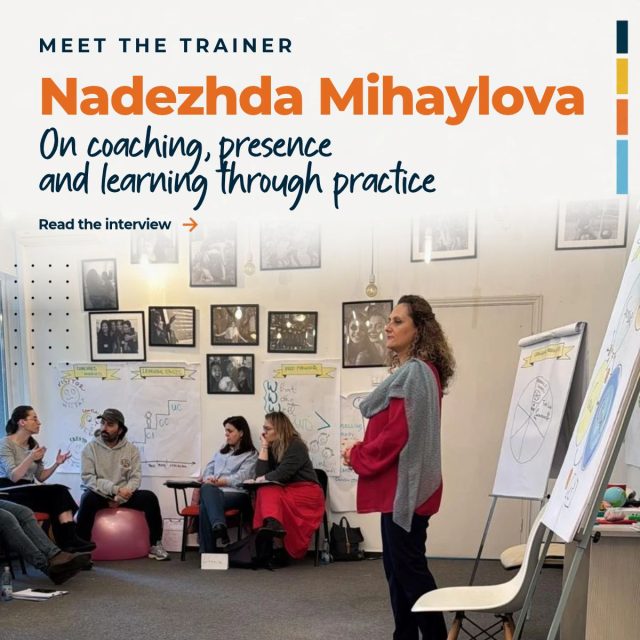
The Art & Science of Coaching is Erickson Coaching International’s award-winning flagship coach training program. It is designed to build practical coaching skills, but many participants describe something more: a change in how they listen, relate and show up in conversations, both professionally and personally.
When we revisit testimonials from our Romanian cohorts, Nadezhda Mihaylova’s presence is repeatedly named as one of the highlights of the learning experience.
This autumn, she returns to Bucharest to facilitate the two Essentials modules of TASC. We invited her to share how she found Erickson, what guides her in the classroom and why the program so often becomes personally transformational.
Question: Can you take us back to the moment you discovered Erickson Coaching? What was different about it that made you choose this path?
Nadezhda Mihaylova: I vividly remember this moment. Picture this: a very busy day in a very busy month, and among the many targets I had, there was one that I dreaded. My manager had just set it as a developmental goal for the following year: “to enroll in a coach certification training.”
Back then, as a Training Manager at a prosperous training and consulting company, I believed that telling people what to do in an interactive and engaging way was the only path to growth and development.
So, that busy afternoon, after receiving my developmental goal, I opened the website of the International Coach Federation with some irritation, only to discover that there were hundreds of schools and thousands of possible programs. And that day, I still had quite a few more tasks to check off my to-do list.
So I shrugged my shoulders, thinking, “I have no time for this now,” and was about to close the page when something grabbed my attention. In the bottom-left corner of the page, a square was blinking in bright orange, reading: art, science, art, science, art, science.
And just like that, I was on a quest.
Several clicks later, followed by a phone call and a sleepless night full of excitement about my new discovery, I was enrolled in The Art & Science of Coaching with Marilyn Atkinson and Erickson Coaching International.
Only years later, while reflecting on that moment, did I realise why, out of the numerous titles on that long list, my attention had been drawn specifically to this one.
Was it because my busy mind needed the blinking square to pause? I don’t think so; there were other ads blinking on that same page.
Was it because I am spontaneous and have no patience for research? Could be. But then it would have been just another training and another target fulfilled.
In my case, it turned out to be a life-changing moment.
Looking back at that moment, I can see that my heart followed the path because “art” – beauty, creation, expression – and “science” – logic, structure, practicality – are guiding values for me and deeply aligned with who I am.
I did not enrol for the curriculum. I enrolled for the calling.
And here I am, sixteen years later: a facilitator, a mentor, and a lifelong student of The Art & Science of Coaching.
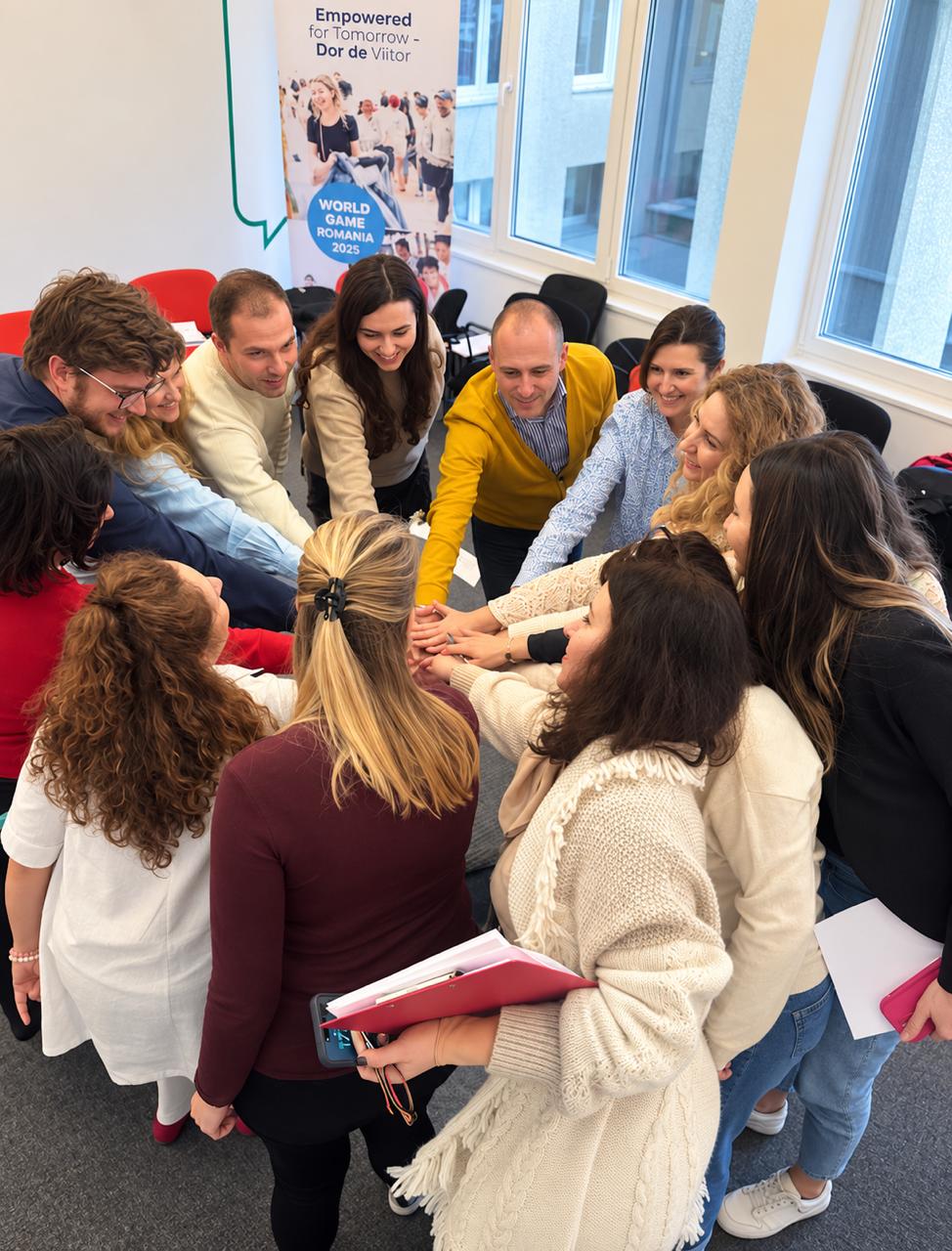
Q: Many participants in Romania describe your presence as one of the highlights of their Erickson journey. What guides you every time you walk into a new classroom?
N.M.: Oh, I am grateful to hear that. Let me see – what guides me when I walk into a new classroom?
Asked this way, the question makes me feel as if you are asking me about a formula, about something intentional. I have no specific rituals of preparation. What guides me when I meet a new person? Is it curiosity about what this relationship will be like? Is it interest in who that person is? A conviction that I am adding value?
I have a firm belief that what I teach and preach and who I am should be one and the same. I do not only teach coaching; I am a coach, even in the classroom. And I’ve extensively tested all the concepts, tools, and processes I share in the program in my own personal and professional life to make sure they are real. I only teach what I believe in. And I believe in what I’ve practiced and what has worked for me and my clients.
But I am also a lifelong learner. I know, this sounds like a cliché. Yet every time I teach coaching, I find myself admiring the questions, comments, and insights that people in the room share. I learn something new every time.
And it is a pleasure to train in Romania because the audience does not take things at face value. This is an audience that goes deep and sincerely wants to understand and integrate. I truly admire this learning style. I just love being with such an audience and co-creating the learning journey together.
Thank you for the question. It made me reflect – and learn.
Q: Erickson is known for its Solution-Focused approach. Beyond the coaching tools themselves, what do you hope people take with them after completing The Art & Science of Coaching?
N.M.: The attitude, not the tools.
The non-judgemental, curious approach to another human being. The attitude that every human being is OK, has the best intentions, and has the necessary resources to create a life of happiness, peace, and joy.
I know that in a world of constant crises and an uncertain future, these principles – towards ourselves and others – might sound naive. We live in an environment where trust and safety are constantly challenged. And I am inviting us to let our guard down and see the other not as a threat to our own success and wellbeing, but as a fellow companion in this complex life – experiencing the same, if not greater, challenges.
This reminds me of a story Marilyn Atkinson shares in her book Transformational Metaphors. Einstein was asked by a journalist, “What is the most important question a scientist should ask?” After a long contemplation, Einstein replied, “The most important question is: Is the Universe a friendly place?”
The young journalist interviewing him was bewildered and a little irritated. He had expected something more sophisticated and scientific, so he asked for an explanation. Einstein replied, “If the Universe is a friendly place, we will spend our lives building bridges; otherwise, we will spend our lives building walls.”
I want to believe that through the coaching mindset, we build bridges and make the world a safer place in a vast yet unknown Universe.
Q: You’ve worked with professionals from many different cultures. Is there something unique you’ve noticed about Romanian participants?
N.M.: I believe that people are people everywhere. And that is why coaching is a global phenomenon – it respects culture but meets the person.
And yet, there is something I have always appreciated when teaching in Romania: the combination of practicality and deep intuition. People in our Romanian classes want to make the coaching process work, but they also want to make it their own – not simply follow the prescribed steps but be fully with the other person.
I truly respect that. To me, this is what makes coaching authentic.
Q: What’s a moment in the classroom that never gets old for you?
N.M.: Every class is a new adventure. The unique combination of people makes each class new to me.
The most exciting part for me is the demos – when the rubber meets the road. There is always a little thrill: Will it work? Will it be convincing enough for the participants to feel confident going into their own practice session?
And now that I am sharing this, I see the image of people coming back from a practice session – their eyes beaming, their sharing full of meaning.
This is what will never get old for me: that genuine “It worked!” moment.
Q: Many people join expecting to learn coaching skills but end up describing the program as personally transformational. Why do you think that happens?
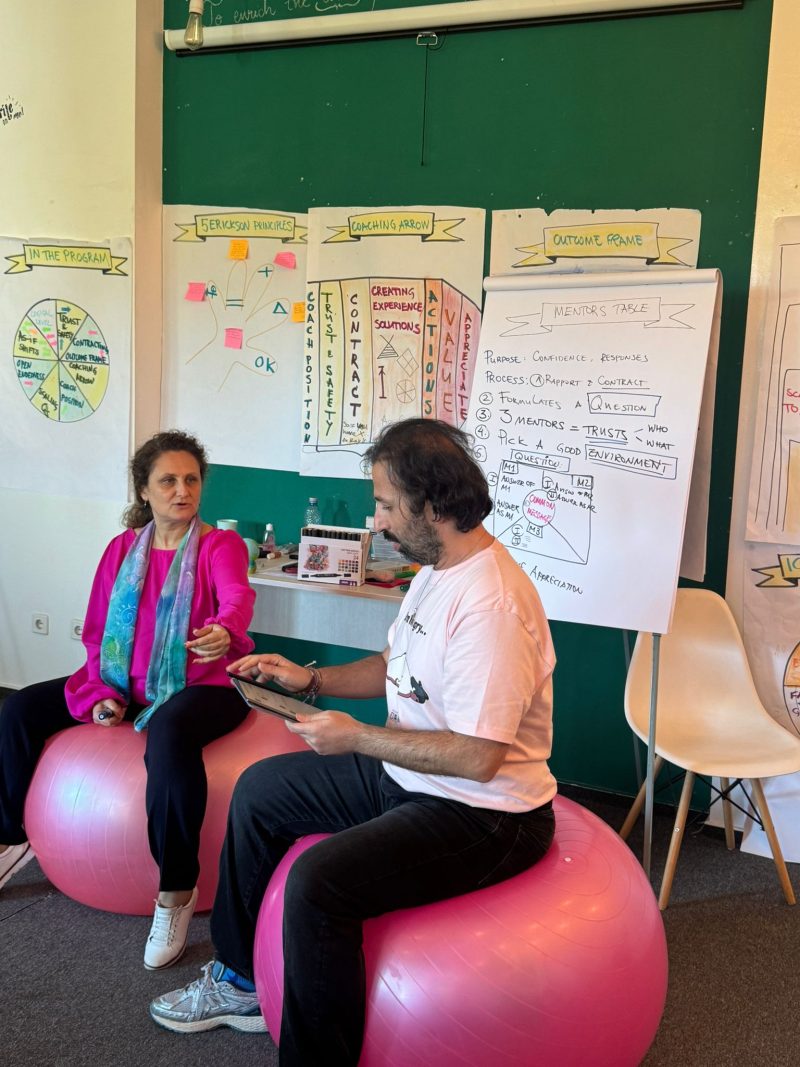
N.M.: This is indeed a common experience, and I am one of the many who have gone through a personal transformation thanks to The Art & Science of Coaching. And the reason is very practical and logical. In The Art & Science of Coaching, we do not talk about coaching – we practice coaching from day one of the program. And people are genuinely and pleasantly surprised by what they discover about themselves in these real coaching moments.
I invite everyone who joins the program to line up their wishes, dreams, and goals – regardless of how rusted they might be – and bring them into the practice sessions, to experience the power of the non-judgemental, curiosity-driven, resource-evoking moments that even newbie coaches are capable of creating.
I would also say that I was not only transformed thanks to the program; I am still transforming and growing. Coaching is not a performance-based discipline; it is a practice grounded in being. There is a saying: “How you coach is who you are; who you are is how you coach.”
Coaching is a journey, not a destination, and the longer we stay on the path, the more we expand and experience the diversity of being human. Self-awareness and continuous learning are part of the “job description” of a coach.
For those who want to venture into coaching, you not only need to be open to change – you need to keep choosing it proactively. Only in this way can you become a container for the growth and transformation of others. Because the coach doesn’t cause the transformation; we develop the capacity to hold the space in which another person’s transformation can happen. That for many is a completely new ball game, and yes – transformational.
Q: Coaching is ultimately about creating change. What change do you hope every participant experiences by the end of the program?
N.M.: Oh, this is not mine to say. Everyone has their own journey and joins the training for their own reasons. All I could recommend is this: come to the training with your own answer to this amazing question: “What is the change you hope to experience for yourself as a result of this investment in you?” And then use the practice sessions and moments of self-reflection to move closer to that desired version of yourself.
And I would add a personal perspective here: change is the natural outcome of awareness and committed action. Change is not the ultimate goal of coaching; it is the aftermath. Coaching evokes awareness, and when the coachee, driven by this awareness, takes action – one step at a time – change becomes inevitable.
Q. If someone is considering joining Erickson this autumn but isn’t sure ”now is the right time” what would you tell them?
N.M.: If not now, when?
What’s at risk if you join now? What’s at risk if you don’t?
Steve Jobs once said: “You can’t connect the dots looking forward; you can only connect them looking backwards.”
I dare you – connect the dots.
_____________________________________________________________
Meet Nadezhda in Bucharest this autumn
The next TASC Essentials cohort begins in Bucharest on 22 October 2026. Nadezhda Mihaylova will facilitate two four-day, face-to-face modules in English:
Essentials Part I · 22–25 October 2026
Essentials Part II · 26–29 November 2026
No previous coaching experience is required. The programme is relevant for aspiring coaches, leaders, managers, HR professionals and anyone who wants to bring more presence, clarity and ownership into the conversations that matter.
The cohort is intentionally small and only a few places remain, allowing for the practice, feedback and connection that make experiential learning possible.
“If not now, when? What’s at risk if you join now? What’s at risk if you don’t?”
Nadezhda Mihaylova
If coaching has been on your mind, perhaps this is the moment to connect the dots.
Discover TASC and reserve your place: https://erickson-coaching.ro/the-art-science-of-coaching/
_____________________________________________________________
Bonus Quiz 😃
One word that describes Romanian coaches.
Curious
One coaching question you never get tired of asking.
“Who do you choose to be now?”
One quality every good coach develops over time.
Being fully present.
The biggest myth about coaching.
“Coaching will set you free you from the 9 to 5 drill.”
Do not seek to leave your current reality. If you leave it prematurely the habits and identities you had developed there will chase you and determine your new set up. Bring coaching where you are first and transform yourself and your current environment with the help of your new coaching mindset – leadership, parenting, relationships. Gradually and effortlessly, this will lead to a new career as a coach, not vice versa.
A book that has influenced your coaching.
Now you got me! Which book hasn’t? 🙂 Everytime I read a book and there is a question in it, I take it as an invitation for contemplation – every book is a great coach. On another note, my bookshelves are full of great books on coaching, it won’t be fair to pick only one. I even co-authored a book with Marilyn Atkinson: “Tell Less, Ask More – An Educational Mantra for Busy Teachers” – it brings our vision of coaching becoming a communication style to the grass roots – homes and schools.
I will share which was the first book from a coach that I read at the start of my journey: “The Inner Game of Tennis” by Timothy Galway. It sounds like a book for sports people but actually it is a true story of everyone who dares to change and grow. And for coaches who want a fresh perspective on presence by someone from a completely different (or maybe not) field, I’d recommend the latest one I am reading: The Music Lesson: A Spiritual Search for Growth Through Music by Victor L. Wooten. It is amazing to be able to learn about presence from one of the greatest bass-guitarists without the word coaching being ever mentioned.
Complete the sentence: “Great coaching begins with…”
Pause
Complete the sentence: “Every participant already has…”
Inner wisdom

Leave a Response