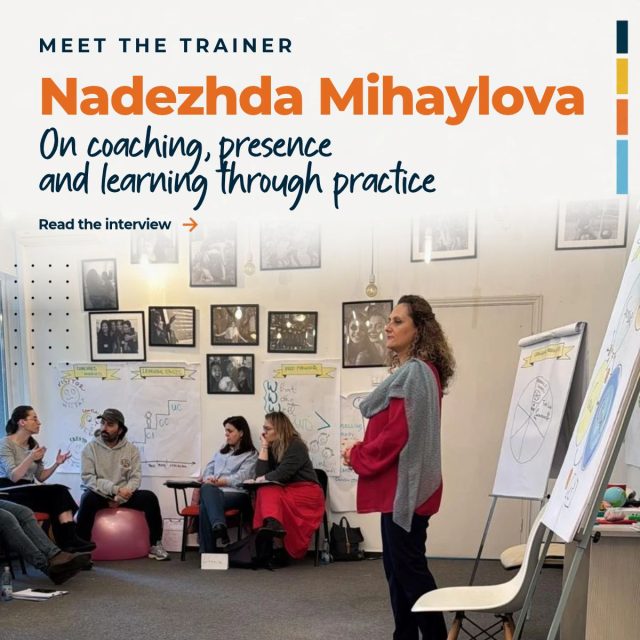
Meet Nadezhda Mihaylova on coaching presence and the courage to change 

The Art & Science of Coaching is Erickson Coaching International’s award-winning flagship coach training program. It is designed to build practical coaching skills, but many participants describe something more: a change in how they listen, relate and show up in conversations, both professionally and personally. 

When we revisit testimonials from our Romanian cohorts, Nadezhda Mihaylova’s presence is repeatedly named as one of the highlights of the learning experience. 

This autumn, she returns to Bucharest to facilitate the two Essentials modules of TASC. We invited her to share how she found Erickson, what guides her in the classroom and why the program so often becomes personally transformational. 

Question: Can you take us back to the moment you discovered Erickson Coaching? What was different about it that made you choose this path? 

Nadezhda Mihaylova: I vividly remember this moment. Picture this: a very busy day in a very busy month, and among the many targets I had, there was one that I dreaded. My manager had just set it as a developmental goal for the following year: “to enroll in a coach certification training.” 

Back then, as a Training Manager at a prosperous training and consulting company, I believed that telling people what to do in an interactive and engaging way was the only path to growth and development. 

So, that busy afternoon, after receiving my developmental goal, I opened the website of the International Coach Federation with some irritation, only to discover that there were hundreds of schools and thousands of possible programs. And that day, I still had quite a few more tasks to check off my to-do list. 

So I shrugged my shoulders, thinking, “I have no time for this now,” and was about to close the page when something grabbed my attention. In the bottom-left corner of the page, a square was blinking in bright orange, reading: art, science, art, science, art, science. 

And just like that, I was on a quest. 

Several clicks later, followed by a phone call and a sleepless night full of excitement about my new discovery, I was enrolled in The Art & Science of Coaching with Marilyn Atkinson and Erickson Coaching International. 

Only years later, while reflecting on that moment, did I realise why, out of the numerous titles on that long list, my attention had been drawn specifically to this one. 

Was it because my busy mind needed the blinking square to pause? I don’t think so; there were other ads blinking on that same page. 

Was it because I am spontaneous and have no patience for research? Could be. But then it would have been just another training and another target fulfilled. 

In my case, it turned out to be a life-changing moment. 

Looking back at that moment, I can see that my heart followed the path because “art” – beauty, creation, expression – and “science” – logic, structure, practicality – are guiding values for me and deeply aligned with who I am. 

I did not enrol for the curriculum. I enrolled for the calling. 

And here I am, sixteen years later: a facilitator, a mentor, and a lifelong student of The Art & Science of Coaching. 
Image Not Found

Q: Many participants in Romania describe your presence as one of the highlights of their Erickson journey. What guides you every time you walk into a new classroom? 

N.M.: Oh, I am grateful to hear that. Let me see – what guides me when I walk into a new classroom?  

Asked this way, the question makes me feel as if you are asking me about a formula, about something intentional. I have no specific rituals of preparation. What guides me when I meet a new person? Is it curiosity about what this relationship will be like? Is it interest in who that person is? A conviction that I am adding value?  

I have a firm belief that what I teach and preach and who I am should be one and the same. I do not only teach coaching; I am a coach, even in the classroom. And I’ve extensively tested all the concepts, tools, and processes I share in the program in my own personal and professional life to make sure they are real. I only teach what I believe in. And I believe in what I’ve practiced and what has worked for me and my clients. 

But I am also a lifelong learner. I know, this sounds like a cliché. Yet every time I teach coaching, I find myself admiring the questions, comments, and insights that people in the room share. I learn something new every time. 

And it is a pleasure to train in Romania because the audience does not take things at face value. This is an audience that goes deep and sincerely wants to understand and integrate. I truly admire this learning style. I just love being with such an audience and co-creating the learning journey together. 

Thank you for the question. It made me reflect – and learn. 

Q: Erickson is known for its Solution-Focused approach. Beyond the coaching tools themselves, what do you hope people take with them after completing The Art & Science of Coaching? 

N.M.: The attitude, not the tools. 

The non-judgemental, curious approach to another human being. The attitude that every human being is OK, has the best intentions, and has the necessary resources to create a life of happiness, peace, and joy. 

I know that in a world of constant crises and an uncertain future, these principles – towards ourselves and others – might sound naive. We live in an environment where trust and safety are constantly challenged. And I am inviting us to let our guard down and see the other not as a threat to our own success and wellbeing, but as a fellow companion in this complex life – experiencing the same, if not greater, challenges. 

This reminds me of a story Marilyn Atkinson shares in her book Transformational Metaphors. Einstein was asked by a journalist, “What is the most important question a scientist should ask?” After a long contemplation, Einstein replied, “The most important question is: Is the Universe a friendly place?” 

The young journalist interviewing him was bewildered and a little irritated. He had expected something more sophisticated and scientific, so he asked for an explanation. Einstein replied, “If the Universe is a friendly place, we will spend our lives building bridges; otherwise, we will spend our lives building walls.” 

I want to believe that through the coaching mindset, we build bridges and make the world a safer place in a vast yet unknown Universe. 

Q: You’ve worked with professionals from many different cultures. Is there something unique you’ve noticed about Romanian participants? 

N.M.: I believe that people are people everywhere. And that is why coaching is a global phenomenon – it respects culture but meets the person. 

And yet, there is something I have always appreciated when teaching in Romania: the combination of practicality and deep intuition. People in our Romanian classes want to make the coaching process work, but they also want to make it their own – not simply follow the prescribed steps but be fully with the other person. 

I truly respect that. To me, this is what makes coaching authentic. 

Q: What’s a moment in the classroom that never gets old for you? 

N.M.: Every class is a new adventure. The unique combination of people makes each class new to me. 

The most exciting part for me is the demos – when the rubber meets the road. There is always a little thrill: Will it work? Will it be convincing enough for the participants to feel confident going into their own practice session? 

And now that I am sharing this, I see the image of people coming back from a practice session – their eyes beaming, their sharing full of meaning. 

This is what will never get old for me: that genuine “It worked!” moment. 

Q: Many people join expecting to learn coaching skills but end up describing the program as personally transformational. Why do you think that happens? 

N.M.: This is indeed a common experience, and I am one of the many who have gone through a personal transformation thanks to The Art & Science of Coaching. And the reason is very practical and logical. In The Art & Science of Coaching, we do not talk about coaching – we practice coaching from day one of the program. And people are genuinely and pleasantly surprised by what they discover about themselves in these real coaching moments.  

I invite everyone who joins the program to line up their wishes, dreams, and goals – regardless of how rusted they might be – and bring them into the practice sessions, to experience the power of the non-judgemental, curiosity-driven, resource-evoking moments that even newbie coaches are capable of creating. 

I would also say that I was not only transformed thanks to the program; I am still transforming and growing. Coaching is not a performance-based discipline; it is a practice grounded in being. There is a saying: “How you coach is who you are; who you are is how you coach.” 

Coaching is a journey, not a destination, and the longer we stay on the path, the more we expand and experience the diversity of being human. Self-awareness and continuous learning are part of the “job description” of a coach. 

For those who want to venture into coaching, you not only need to be open to change – you need to keep choosing it proactively. Only in this way can you become a container for the growth and transformation of others. Because the coach doesn’t cause the transformation; we develop the capacity to hold the space in which another person’s transformation can happen. That for many is a completely new ball game, and yes – transformational.  
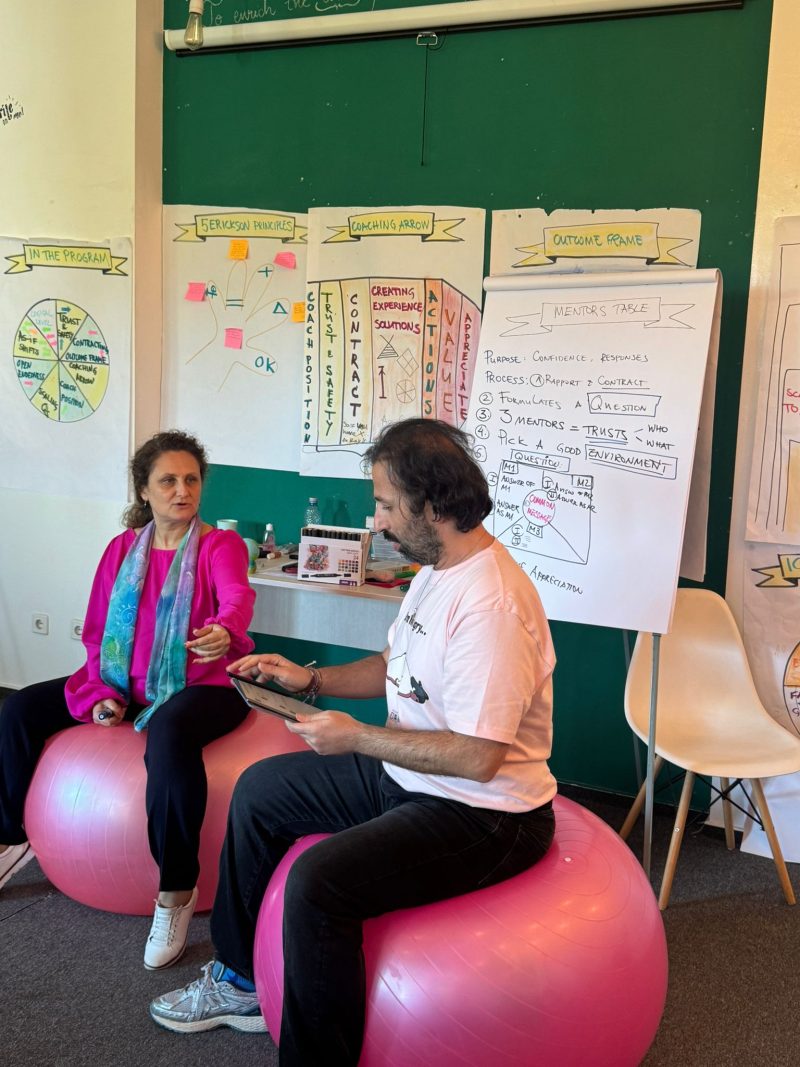
Image Not Found

Q: Coaching is ultimately about creating change. What change do you hope every participant experiences by the end of the program? 

N.M.: Oh, this is not mine to say. Everyone has their own journey and joins the training for their own reasons. All I could recommend is this: come to the training with your own answer to this amazing question: “What is the change you hope to experience for yourself as a result of this investment in you?” And then use the practice sessions and moments of self-reflection to move closer to that desired version of yourself. 

And I would add a personal perspective here: change is the natural outcome of awareness and committed action. Change is not the ultimate goal of coaching; it is the aftermath. Coaching evokes awareness, and when the coachee, driven by this awareness, takes action – one step at a time – change becomes inevitable. 

Q. If someone is considering joining Erickson this autumn but isn’t sure ”now is the right time” what would you tell them? 

N.M.: If not now, when? 

What’s at risk if you join now? What’s at risk if you don’t? 

Steve Jobs once said: “You can’t connect the dots looking forward; you can only connect them looking backwards.” 

I dare you – connect the dots. 

_____________________________________________________________ 

Meet Nadezhda in Bucharest this autumn 

The next TASC Essentials cohort begins in Bucharest on 22 October 2026. Nadezhda Mihaylova will facilitate two four-day, face-to-face modules in English: 

Essentials Part I · 22–25 October 2026 

Essentials Part II · 26–29 November 2026 

No previous coaching experience is required. The programme is relevant for aspiring coaches, leaders, managers, HR professionals and anyone who wants to bring more presence, clarity and ownership into the conversations that matter. 

The cohort is intentionally small and only a few places remain, allowing for the practice, feedback and connection that make experiential learning possible. 

“If not now, when? What’s at risk if you join now? What’s at risk if you don’t?” 

Nadezhda Mihaylova 

If coaching has been on your mind, perhaps this is the moment to connect the dots. 

Discover TASC and reserve your place: https://erickson-coaching.ro/the-art-science-of-coaching/ 

_____________________________________________________________ 

Bonus Quiz 😃 

One word that describes Romanian coaches.  

Curious  
 

One coaching question you never get tired of asking.  

“Who do you choose to be now?” 
 

One quality every good coach develops over time. 

Being fully present. 

The biggest myth about coaching. 

 “Coaching will set you free you from the 9 to 5 drill.”  

Do not seek to leave your current reality. If you leave it prematurely the habits and identities you had developed there will chase you and determine your new set up. Bring coaching where you are first and transform yourself and your current environment with the help of your new coaching mindset – leadership, parenting, relationships. Gradually and effortlessly, this will lead to a new career as a coach, not vice versa. 
 

A book that has influenced your coaching.  

Now you got me! Which book hasn’t? 🙂  Everytime I read a book and there is a question in it, I take it as an invitation for contemplation – every book is a great coach. On another note, my bookshelves are full of great books on coaching, it won’t be fair to pick only one. I even co-authored a book with Marilyn Atkinson: “Tell Less, Ask More – An Educational Mantra for Busy Teachers” – it brings our vision of coaching becoming a communication style to the grass roots – homes and schools.   

I will share which was the first book from a coach that I read at the start of my journey: “The Inner Game of Tennis” by Timothy Galway. It sounds like a book for sports people but actually it is a true story of everyone who dares to change and grow. And for coaches who want a fresh perspective on presence by someone from a completely different (or maybe not) field, I’d recommend the latest one I am reading: The Music Lesson: A Spiritual Search for Growth Through Music by Victor L. Wooten. It is amazing to be able to learn about presence from one of the greatest bass-guitarists without the word coaching being ever mentioned.  

Complete the sentence: “Great coaching begins with…”  
Pause 
 

Complete the sentence: “Every participant already has…”  

Inner wisdom 


Understanding the Difference: Coaching, Mentoring, and Training

In the world of personal and professional development, coaching, mentoring, and training each play unique roles. Understanding these differences can help you choose the right approach for your needs.

Coaching

Definition: Coaching is a structured process focused on helping individuals achieve specific goals through self-discovery and action planning. It involves asking powerful questions and facilitating solutions.

When to Use: Use coaching when you need personalized support to achieve specific objectives, improve performance, or develop new skills. It’s ideal for enhancing leadership, career progression, and personal growth.

Example: Erickson’s coaching programs, which use a solution-focused approach to drive transformation.

Mentoring

Definition: Mentoring involves a more experienced individual (the mentor) providing guidance, advice, and support to a less experienced person (the mentee). It’s typically a long-term relationship focused on career and personal development.

When to Use: Use mentoring when seeking wisdom and guidance from someone who has navigated similar career paths or challenges. It’s beneficial for career development, knowledge transfer, and personal growth.

Example: A senior executive mentoring a junior manager on career progression and leadership skills.

Training

Definition: Training is a structured program designed to impart specific skills or knowledge. It often involves formal instruction, practice, and assessment.

When to Use: Use training when there is a need to learn new skills or knowledge quickly and efficiently. It’s ideal for onboarding, technical skill development, and compliance requirements.

Example: A corporate training session on new software implementation.

When to Use Each Approach

  • Coaching is best for individualized development and achieving specific goals.
  • Mentoring is suited for long-term career and personal growth through experienced guidance.
  • Training is ideal for acquiring new skills and knowledge in a structured environment.

Blending Approaches

In many cases, blending coaching, mentoring, and training can provide comprehensive development. For instance, an Erickson coach can help you set and achieve personal goals, while mentoring can provide ongoing career guidance, and training can equip you with necessary skills.

Choosing the Right Path with Erickson

At Erickson Coaching International, we specialize in coaching that empowers individuals to achieve their fullest potential. Our programs are designed to complement other development methods like mentoring and training, ensuring a holistic approach to your growth.


Unlocking Your Leadership Potential

Leadership is more than a title; it’s about inspiring and guiding others towards a shared vision. At Erickson Coaching International, we believe that every individual has the potential to be a great leader. Our coaching programs are designed to help you discover and harness this potential.

Self-Awareness and Emotional Intelligence

Effective leadership begins with self-awareness. Understanding your strengths, weaknesses, and values is crucial for authentic leadership. Erickson’s coaching programs emphasize self-reflection and emotional intelligence, equipping you with the skills to manage your emotions and understand others better. This foundation allows you to build trust and foster a positive work environment.

Strategic Thinking and Decision Making

Leaders are often faced with complex decisions that require strategic thinking. Erickson’s solution-focused approach helps you develop clarity and creativity in your decision-making processes. By focusing on solutions rather than problems, you can navigate challenges with confidence and inspire your team to do the same.

Effective Communication and Influence

Communication is at the heart of leadership. Erickson coaches teach techniques for effective communication that enhance your ability to influence and motivate others. Whether it’s delivering a compelling presentation or facilitating a difficult conversation, strong communication skills are essential for successful leadership.

Building and Leading Teams

Leadership is not just about individual performance; it’s about building and leading high-performing teams. Erickson’s Team Coaching Certification provides you with tools to improve team dynamics, foster collaboration, and drive collective success. Understanding how to leverage the strengths of each team member and create a cohesive unit is vital for any leader.

Continuous Learning and Growth

Leadership is a journey of continuous learning and growth. Erickson offers advanced coaching programs that keep you updated with the latest in leadership development and coaching methodologies. Engaging with a global network of coaches and participating in ongoing professional development ensures that you remain at the forefront of leadership excellence.

Why Choose Erickson?

Erickson Coaching International stands out due to its comprehensive and accredited coaching programs. Our commitment to excellence, combined with a solution-focused approach, ensures that you receive the best training to unlock your leadership potential.

Start Your Leadership Journey

Embark on your leadership journey with Erickson and transform your potential into impactful leadership. With our expert guidance and supportive community, you can achieve new heights in your personal and professional life.


Exploring the Power of Coaching

Coaching is a transformative process that empowers individuals to achieve their fullest potential, both personally and professionally. At its core, coaching focuses on facilitating self-discovery, setting and achieving goals, and fostering growth through guided conversations and strategic questioning.

Unleashing Potential

Coaching helps individuals unlock their inherent strengths and capabilities. By focusing on solutions rather than problems, coaching encourages clients to envision their desired future and take actionable steps towards it. This solution-focused approach, championed by Erickson, ensures that clients are always moving forward, creating positive change in their lives.

Personal Growth and Self-Awareness

One of the most significant benefits of coaching is the enhancement of self-awareness. Through reflective practices and insightful feedback, clients gain a deeper understanding of their values, beliefs, and behaviors. This self-awareness is crucial for personal growth, enabling individuals to make informed decisions that align with their true selves.

Professional Development

In the professional realm, coaching can lead to remarkable improvements in performance, leadership, and career satisfaction. Coaches work with clients to identify career goals, develop strategic plans, and navigate challenges effectively. This support is invaluable for professionals looking to advance their careers, improve their leadership skills, or transition into new roles.

Enhanced Relationships and Communication

Coaching also significantly improves interpersonal relationships and communication skills. By learning effective communication techniques and developing empathy, clients can build stronger, more meaningful connections with others. This is particularly beneficial in team settings, where enhanced communication can lead to improved collaboration and productivity.

Stress Management and Well-Being

In today’s fast-paced world, stress management is essential. Coaching provides clients with tools and strategies to manage stress, maintain work-life balance, and enhance overall well-being. This holistic approach ensures that clients are not only successful but also healthy and fulfilled.

Why Erickson?

Erickson International stands out in the coaching world due to its commitment to excellence and innovation. With programs accredited by the International Coaching Federation (ICF), Erickson provides high-quality training that meets global standards. Their solution-focused methodology ensures that coaches are equipped to drive real, sustainable results for their clients.

Start Your Coaching Journey

Whether you’re looking to become a coach or seeking personal development, exploring the power of coaching can be a life-changing decision. With Erickson’s comprehensive programs and supportive community, you can embark on a journey of transformation and growth.


Why Choose Erickson for Your Coaching Journey?

Choosing the right coaching program is crucial for your success and development as a coach. Erickson International offers unparalleled benefits that make it the top choice for aspiring coaches in Romania.

ICF Accreditation: A Mark of Quality

Erickson’s programs are accredited by the International Coaching Federation (ICF), ensuring you receive training that meets the highest standards in the industry. This accreditation not only enhances your credibility but also opens up global opportunities, as ICF credentials are recognized worldwide.

Solution-Focused Approach: Drive Real Results

Erickson’s unique solution-focused methodology is designed to help clients find actionable solutions rather than dwelling on problems. This approach is highly effective in fostering quick and sustainable transformations, making your coaching more impactful and rewarding.

Global Network and Community

By joining Erickson, you become part of a global network of coaches and alumni. This community provides continuous support, opportunities for collaboration, and access to a wealth of resources, helping you grow both personally and professionally.

Comprehensive Curriculum: Tailored to Your Needs

Erickson offers a comprehensive range of programs, from foundational courses like The Art & Science of Coaching to specialized certifications in Team Coaching and NLP. This allows you to tailor your learning journey according to your career goals and interests.

Experienced Faculty: Learn from the Best

Erickson’s faculty comprises experienced coaches and industry leaders who bring real-world expertise into the classroom. Their guidance and mentorship are invaluable in helping you develop the skills and confidence needed to excel as a coach.

Flexible Learning Options

Understanding the diverse needs of learners, Erickson provides flexible learning options, including online courses and in-person workshops. This flexibility ensures you can balance your professional development with other commitments.

Proven Track Record

With over 40 years of experience and thousands of successful graduates, Erickson has a proven track record of excellence in coaching education. Testimonials and success stories from alumni around the world attest to the life-changing impact of Erickson’s programs.

Cultural Relevance and Adaptability

Erickson’s programs are designed to be culturally adaptable, ensuring that the coaching techniques and methodologies are relevant and effective within the Romanian context. This cultural sensitivity enhances your ability to connect with and support your clients effectively.

Start Your Coaching Journey with Erickson Romania

Embarking on your coaching journey with Erickson means joining a prestigious institution dedicated to your success. Whether you aim to coach individuals, teams, or organizations, Erickson’s programs provide the knowledge, skills, and support you need to make a significant impact.

Choose Erickson and transform lives through the power of coaching.


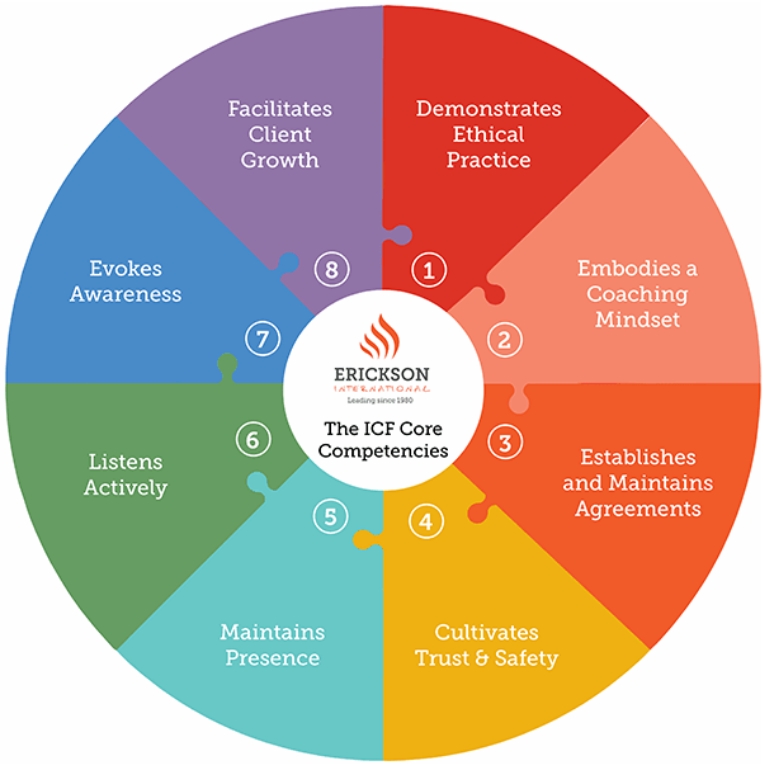
The ICF Core Competencies: 2021 Update

Following a rigorous analysis process, the International Coach Federation (ICF) has released an updated ICF Core Competency model that is to be officially implemented in accredited coach training programs during early to mid 2021. The updated model reflects the collective insights and wisdom shared by coach practitioners through this comprehensive research initiative.

As of February 1st, 2021, Erickson’s has incorporated the updated Core Competencies into all three of The Art & Science of Coaching programe paths namely the Erickson Solution-Focused Coach Diploma, Certification and the Qualification paths. This means any new series of Modules that began on or after that date are now explicitly training the updated model.

Interested in developing your professional skills as a coach? Discover how Solution Focused Coaching Skills enable you to create transformational change in yourself and others.

Erickson is proud to incorporate the updated model as much of it reflects the essential elements and methods taught in our coach training programs that we have developed over the course of three plus decades of practice, feedback and research.  We believe our coach training standards are one of the highest in the world and that the coaching model we teach exceeds the minimum criteria set out by the ICF.

With this updated model, the ICF aims to address the global shifts in coaching since the initial release of the Core Competencies in 1998. The ICF reached out to subject matter experts in the coaching field, including many practicing Erickson-trained coaches, to discover how the field has evolved and how the core competencies can be improved. From the existing 11 Core Competencies, the ICF has applied this analysis and refined it into 8 Core Competencies that streamline, enhance and provide a more cohesive, succinct list of the fundamental competencies of the coaching process.

The core themes that came out of the ICF’s research and provided a basis for the updates are:

  • That ethical behaviour and confidentiality are paramount
  • Expansion of the coaching agreement (organizational, overall client engagement, session)
  • Enhancement of the partnership concept – client has an equal voice in the process, and there is mutual accountability for coach and client. The coach is accountable for the coaching process, the client is accountable for their own growth.
  • The concept of professional development & reflective practice
  • The integration of client context and culture. This includes their family structures, values, beliefs, and past experiences. Looking at the client from a holistic view.

Four Ways We Sabotage Ourselves and How to Move Forward

What Are Your Inner Gremlins? Do You Know Your Inner Gremlins?

You’ve probably already guessed: We’re not talking about real mischievous gremlins here. Instead, our definition of a gremlin is more of a what than a who.

A gremlin, in coaching terms is a habit that stops people from achieving their goals in business or life. A gremlin is an internal habit or a feeling that seems to run on its own accord-something that rises up and then stops you from taking action on, or completing, a particular phase of a project.

However, gremlin-thinking doesn’t have to win out. When you confront a gremlin and question its validity, you gain the wisdom and learn the lessons needed to bypass it. To start, try asking yourself gremlin-busting questions, like: Where in my life do I suffer from self-sabotaging mechanisms? How will my life change as I learn to let go of these gremlins? Self-sabotaging behavior is one example of a gremlin. Let’s look in details at what the four key gremlins are.

Fear of dreaming

Some people are afraid to even consider their dreams, such as: starting a business or meeting a great partner, training for a marathon. Maybe they don’t believe they have the talent, intelligence or self-worth for these desires to manifest. Often times, past disappointments have been internalized to the point where they become procrastination habits. The result: being afraid to even consider what is possible. People with this gremlin experience their life from this place of loss of choice as if this were their destiny.

People stuck at this stage need loving support to discover their true vision. Working with a supportive coach can clear up the negative activity and inner conclusions around this old fear system. People are often surprised at how quickly they can tune into their dreams and learn to make them real when they shift their focus and begin to see what is possible for them.

Fear of failure

Some people get easily inspired by their dreams and take immediate action. Yet, they have difficulty executing what they start. People with this gremlin can literally be a victim of their own minds by sabotaging themselves with their thoughts and beliefs about their lack of resources, capabilities, and skill requirements.

The fear-of-failure folks need to build the inner conviction that they are capable of making their dream come true. When these people explore their inner values and capabilities, they build clarity around positive imaging and results thinking. They benefit from establishing a micro-visionary practice while seeing what they are building with detailed step-by-step organization. Seeing themselves moving towards a big sales goal through achieving weekly targets begins to build their inner map of success.

Fear of upsetting people

This gremlin develops when people fear the dissatisfaction or rejection of others as they move toward success. People sabotage themselves with these thoughts and beliefs, blaming external conditions for whatever appears to be stopping them. Thoughts such as I can’t do this because of my flawed culture, flawed government, flawed organization, flawed family, flawed relationship grab a person’s attention and result in cynical observation or wait-and-see mode.

To move past this gremlin, these people need to focus on, reach for, and explore what they can control. And we can always control our higher values and whatever we consider meaningful in our lives. Focusing on these deeper values allows for renewed forward movement. Consequently, People who have been stuck with this gremlin will eventually move beyond the pack and the limited system consciousness they’ve settled into by connecting to their authentic, personal values.

Fear of conflict

This is the gremlin that often stops completion of a project. One way this gremlin appears as a fear of expressing authentic values when others might be harmed or claim they’ll be harmed by this expression. Another way this shows up is through time and priority management conflicts. We play it safe and remain in indecision rather than moving forward. Instead of completing something important to us, we don’t find the time. Avoidance becomes the gremlin – true? This is something simple and concrete we can all grasp – also you can have some fun here too… asking your clients…Have you ever tried a little avoidance?

It is only when we declare our deep commitment to our values and learn to move forward courageously, that we can begin to move beyond this gremlin. When people dedicate themselves to focusing on their own inner integrity and alignment with their values, they begin to conduct their lives in a whole new way. They discover a new capacity for independence by sustaining their own authentic values. The person can truly begin to experience high levels of inner trust as well as inner satisfaction. The result is a legacy of purpose that can be passed on and becomes a gift to others. This is the territory of true inner and outer leadership.

Conclusion

The important thing to know is that it is possible and in many cases easy to tame and align your gremlins. How might you begin to apply your newfound awareness of gremlins to support yourself in living the life you love?


What is Solution-Focused Coaching. And what it’s not!

Have you wondered what exactly is coaching? If this is your first experience with the Erickson Coaching International, let’s start off this conversation

As a Master Coach, Marilyn Atkinson (the Founder of Erickson Coaching International) helped us to capture what coaching is all about. Marilyn has been coaching, writing on the subject, and training executive and life coaches for over 30 years in North American and around the world. Marilyn’s definition of what coaches do is very different from the initial perception some people might have. To quote Marilyn:

“Coaches help people discover and live their true purpose.”

“Great coaches recognize that everyone already has the answers and the capabilities to be successful, provided the coach continues to ask the right questions, in the right way and at the right time.“

4 Pillars of Erickson Coaching Methodology

Solution-Focused

Moves your client towards their desired future outcomes, instead of concentrating on past experiences or reasons for present dissatisfaction.

Systemic

Emphasizes the holistic nature of your client, seeing how positive change can fit into their bigger picture.

Client-Centered

Allows you to trust your client’s inner resources and skills, respecting their agenda and future outcomes. Coaching is an advice-free zone.

Action-Oriented

Pursues transformational change in specific, inspired steps that lead to fundamental shifts in attitude, behavior and habit formation.


What Coaching is not?


It’s not…

Counselling


Unlike therapists and counselors, coaches don’t focus on the childhood or past experiences that might be the root of the way a person lives or feels. Instead they help their clients get clear on what they want in the future, why they want it, and how they are going to achieve it.


It’s not…

Consulting

Consultants diagnose the needs of an organization or individual and offer their own solutions based on their specialized expertise to ‘fix’ the problem; solutions which they often implement for the client as well. Coaches use tools and processes to help clients to generate their own solutions and then hold them accountable for following through.


It’s not…

Sports Coach 

Someone new to coaching might hear the word “coach” and think football, but sports coaches generally are in charge, setting the goals and the path to victory. Teaching, correcting, and managing are all skills a sports coach would use. Professional life, business or executive coaching is the opposite; it’s the client who sets the goals.